Performance systems based on AI are becoming increasingly used to monitor, compare, and evaluate workers, but the question is when supposedly age-neutral data does lead to age-based disadvantage. The introduction of datafied ageism: an unfair form of disadvantage because the algorithmic performance visibility does not appropriately reflect the occupational advantage or disadvantage, or because the algorithm uses proxies that are age-correlated, or because it is based on non-representative benchmarks, or because it keeps the scores beyond their valid context, or because the score is not easily interpreted or appealed. This framework is applied to a preregistered longitudinal quasi-experimental study with 4,800 workers in 48 units from 24 organizations and followed for five waves. The following worker fixed-effects models, cohort-stacked event studies, criterion-validity tests, cluster-bootstrap mediation, exit models, inverse-probability weighting, and multiple robustness checks were used. There were no pre-adoption trends. System adoption reduced workplace dignity (β = -0.084, 95% CI [-0.116, -0.052]) and increased capability-conversion loss (β = 0.033, 95% CI [0.002, 0.063]). The impacts were worse in age-incongruent systems, and less in inclusive governance. This was also the case for older workers, who were systematically underpredicted and had three times the likelihood of a false negative classification. Loss of dignity and capability had a mediating impact on employability and retirement intention. The study sets out a cumulative evidentiary standard for diagnosis of "datafied" ageism, and offers a replicable framework for field validation.
Research ArticleAI and Age at WorkIn progress
Datafied Ageism at Work: How AI-Based Performance Visibility Shapes Dignity and Late-Career Sustainability
Correspondence: abdyeaqubi@gmail.com
Abstract
Keywords Datafied ageismAlgorithmic managementElectronic performance monitoringWorkplace dignityOlder workersEmployabilityRetirement intentionAlgorithmic fairness
Introduction
More and more organisations are turning work into data. Pace and location are monitored at the warehouse, talk time, adherence and resolution are measured at the call centre, activity and task switching are measured at productivity systems and platforms continuously rate workers to rank them. These systems expand managerial visibility and translate work into durable records that can shape scheduling, pay, training, discipline, redeployment, and exit (Ball, 2010; Kellogg et al., 2020; Ravid et al., 2020). It comes as part of the population ageing and the policies favouring longer working lives. But while chronological age is not a reliable predictor of overall job performance, workplace age stereotypes are still very present (Posthuma & Campion, 2009).
Algorithmic systems may reduce arbitrary human judgment, but they can also institutionalize narrow or historically biased definitions of competent work. Validity, however, doesn't mean consistency. Just because there is an age difference in a performance score, it does not mean that this is evidence of ageism. Variances may be reflective of assignments, tenure, health, training, occupational knowledge or other strategies to affect quality and safety. However, if both age groups have an equal average score, but the pattern of scores from each to the prediction differs or the consequences are different, then it is not fair. It is necessary, therefore, to differentiate descriptive disparity, measurement validity, causal system effects and downstream decisions in the analysis.
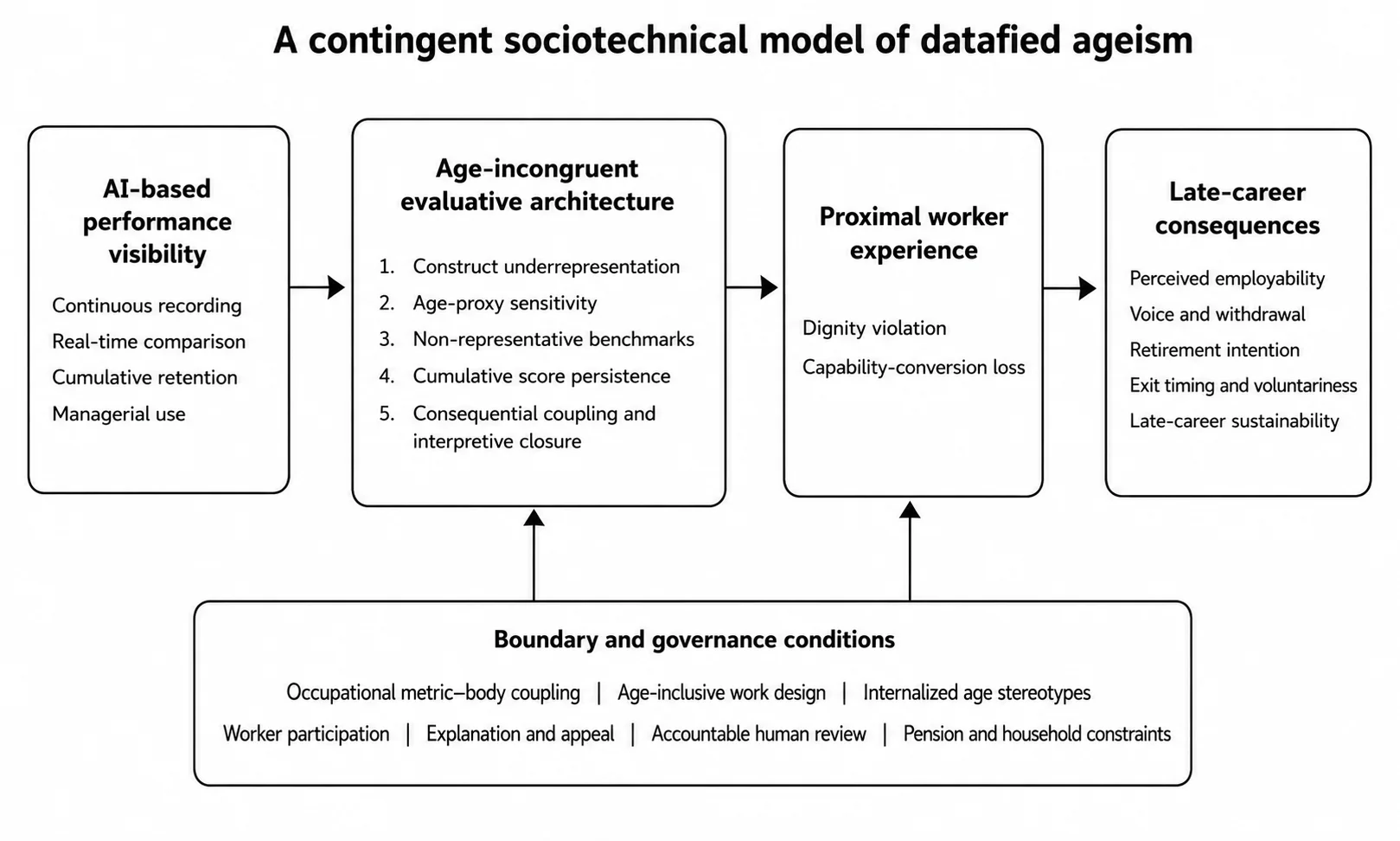
We describe datafied ageism as the creation of age-stratified disadvantage as a result of the lack of age-inclusive evaluative validity of algorithmic performance systems. Its mechanisms include construct underrepresentation, age-proxy sensitivity, non-representative benchmarking, persistent scoring, and consequential decisions with limited contestability. These processes can contribute to a loss of dignity and to the loss of capability, the failure to convert experience, health, judgment, and effort into something the organization values and rewards. Contributions the article makes to the research include separating monitoring intensity from design that is age-invalid, combining dignity, capability, stereotype-embodiment, and life-course perspectives, conducting a transparent longitudinal simulation with staggered adoption, validity analysis, mediation, competing exits, attrition adjustment, and clustered robustness tests.
It suggests that diagnosis of the datafied ageism can only be made when the disparate experiences documented through convergent evidence, predictive validity, system architecture, consequences, and worker outcomes.
Research Context and Literature Review
From electronic monitoring to algorithmic evaluation
Depending on task and organizational context, electronic performance monitoring can lead to gains in productivity, but can also create greater stress, privacy issues, and procedural-justice sensitivity (Ball, 2010). Modern algorithmic systems use predictive, ranking, recommending and automated consequences to enhance the monitoring process by continuously gathering data. Instead of simply being observed, performance and employability is being computed (Jarrahi et al., 2021; Kellogg et al., 2020; Parent-Rocheleau & Parker, 2022; Ravid et al., 2020). Algorithmic control is not a natural outcome of a specific algorithm. Flexibility is found to be compatible with behavioural control, information asymmetry, rating dependence and limited contestability (Curchod et al., 2020; Duggan et al., 2020; Gandini, 2019; Möhlmann et al., 2021; Veen et al., 2020; Wood et al., 2019). In turn, transparent criteria and meaningful human input should decrease the discretion and arbitrary nature of decisions. The question is, how does an evaluative system define “valid contribution” and distribute error, and how does it relate scores to opportunity (Bankins et al., 2022; Bernstein, 2017; Kornberger et al., 2017; Lee, 2018; Newman et al., 2020).
Age, performance, and organizational valuation
There is no evidence that performance in a job declines with age; for this, experience, health, job design and opportunity are likely more important. Despite this, the stereotype of aging affects hiring, promotion, training and workplace treatment (Dordoni & Argentero, 2015). What is important to remember is that there are multiple ways to achieve competent performance. Changes in pace or stamina can be compensated in older workers by way of experience, error prevention, relational continuity and strategic pacing (Truxillo et al., 2015; Zacher, 2015). The metrics that have been used to support speed over quality can then produce disadvantage based on age even if age is not a part of the model. The age-inclusive practices that are relevant in an organisation include health support, knowledge transfer, career development, and transition assistance (Wilckens et al., 2021).
Dignity, capability, and sustainable late careers
The concepts of dignity at work include recognition, autonomy, voice, and being treated as a person (Blustein & Allan, 2025; Thomas & Lucas, 2019). In terms of meaningful working research, there is a focus on meaning, purpose, and contribution (Allan et al., 2019). If the algorithmic scores replace the contextual knowledge, not only is the measure inaccurate, but the opportunity for workers to make a legitimate contribution is not made visible organizationally. These impact on employability and retirement. Perceived employability is a worker's ability to access or maintain a desired job and is influenced by skills, labour-market structure, and organisational opportunity (Vanhercke et al., 2014). Work quality, health, pension eligibility, household circumstances, and perceived alternatives are also important factors in retirement, along with retirement itself (Fisher et al., 2016). In the current model, algorithmic assessments are related to these end-of-career outcomes, but age is not automatically a source of performance decrease.
Theoretical Framework
Algorithmic Performance Systems as Evaluative Infrastructures
The algorithmic management relies on digital systems to track workers, analyze their performance and distribute opportunities. Mechanisms mentioned in the research include recording, rating, restricting, rewarding and replacing, among others, as well as issues of opacity, autonomy, fairness, and resistance (Bujold et al., 2022; Kellogg et al., 2020; Lee, 2018; Möhlmann et al., 2021). The following accounts, however, do not provide a complete account of when digital control becomes age-stratified. An evaluative-infrastructure approach to metrics sees metrics as 'value-institutions' rather than as neutral measurements (Kornberger et al., 2017). Systems decide what is considered performance, how workers are evaluated, how high scores remain, and what the outcome of high scores is. Measures could thus be oriented towards speed, throughput, or activity visible to others and completely neglect consideration of safety, continuity, and error prevention. Evaluation of algorithms is not bad. Centrally, transparent, validated, multidimensional, and contestable systems can minimise stereotyping that is arbitrary and enhance accountability. The age-incongruent architecture of evaluation is therefore contrasted with age-inclusive architectures of evaluation, not with technology and without technology (Bankins et al., 2022).
Datafied Ageism
Datafied ageism is age-stratified disadvantage created when algorithmic performance systems do not have age-inclusive validity. It is a phenomenon that happens when age-related residues are considered as adequate proxies for value, when the heterogeneous workforce is not considered when setting the benchmarks, when decision consequences are taken without any meaningful review, when age-related traces do not correspond to the valid context. Five mechanisms underpin the construct: construct underrepresentation, age-proxy sensitivity, non-representative benchmarking, cumulative score persistence, and consequential coupling with interpretive closure. All together, these processes can suppress appreciated contributions, punish age-correlated features, enforce inappropriate norms and expectations, transform transient variations into permanent identities, and evoke decisions without a legitimate recourse. Datafied ageism is thus more than just demographic inequity. To diagnose, convergent evidence that a system misrepresents contribution that it predicts outcomes differently by age and equalizes consequential errors is necessary. While formal age blind and overall accuracy are not sufficient indicators of substantive fairness (Kleinberg et al., 2018; Newman et al., 2020).
Dignity and Capability Conversion
There are four aspects of dignity at work: recognition, autonomy, voice, and respect. It is at risk when workers are being used as 'scores', when knowledge is being neglected in task situations, and when decisions are not subject to scrutiny (Lucas, 2015). The capacity approach questions the ability of institutions to turn resources into desired results (Sen, 2001). We define capability-conversion loss as a diminished opportunity to convert experience, health, effort, expertise, and judgment into recognized contribution. These ideas are linked, but different - although scores are accurate, monitoring can infringe upon dignity, and if scores are not being used, narrow metrics can limit opportunity without being disrespectful. The separation helps to distinguish their various mechanisms and consequences.
Embodiment, Employability, and Life-Course Exit
Stereotype embodiment theory helps to understand how beliefs about age make themselves salient and can influence behavior and performance. When numerical feedback is repeated and identities are consistently assigned to individuals based on age, rather than other harms, and when no option exists for other evidence or appeals, age-based identities can be reinforced (Lamont et al., 2015). Life-course theory brings in time context: adverse evaluation is dependent on the pension eligibility, health, caregiving, financial, and employment options (Komp-Leukkunen, 2023). The desired outcome relates to late career sustainability - being able to stay, transfer to a new career, work reduced hours, or leave while maintaining dignity, health, employability, agency, and valuable contribution. The model thus connects evaluative architecture to the experiences of dignity violation and loss of capabilities for conversion, to employability, to intention to retire, and to different exit strategies, such as retirement, resignation, redeployment, reduced hours, or limited continuation.
Table 1. Construct differentiation and evidentiary implications
| Concept | Primary locus | Necessary evidence | What it does not establish |
|---|---|---|---|
| Electronic performance monitoring | Observation intensity | Capture frequency, visibility, privacy, and stress responses | Age-based disadvantage or invalid performance representation |
| General algorithmic bias | Model or data disparity | Group-differentiated error or outcome distribution | A workplace-specific mechanism or late-career pathway |
| Interpersonal ageism | Attitudes and discretionary treatment | Age stereotypes, discriminatory decisions, or a hostile climate | Systemic disadvantage without a biased individual actor |
| Datafied ageism | Sociotechnical evaluative architecture | Age-differential within-worker effects, audit evidence, criterion invalidity, consequential threshold error, and weak contestability | That monitoring or any age difference is intrinsically discriminatory |
Note. The defining evidentiary claim is cumulative: no single disparity, perception, or accuracy statistic is sufficient to diagnose datafied ageism.
Hypotheses
Hypothesis 1: Algorithmic-system adoption will reduce workplace dignity more strongly at older ages, particularly where age-incongruent evaluative architecture is high.
Hypothesis 2: Algorithmic-system adoption will increase capability-conversion loss more strongly at older ages and in age-incongruent systems.
Hypothesis 3: Inclusive governance- worker participation, contextual review, explanation, appeal, and accountable human oversight will attenuate age-differential effects on dignity and capability-conversion loss.
Hypothesis 4: After adoption, performance scores from age-incongruent systems will underpredict objective quality for older workers and produce a higher false-negative classification rate at consequential thresholds.
Hypothesis 5: Dignity decline and capability-conversion loss will transmit adverse effects to perceived employability and retirement intention.
Hypothesis 6: Retirement intention will predict subsequent retirement, while direct system effects on realized exit will be weaker and more contingent than effects on proximal outcomes.
Note. The model distinguishes performance visibility from the age-incongruent architecture and governance conditions that determine whether visibility produces disadvantage.
Methods
Study Status and Analytical Purpose
This is an experimental proof. All data analyzed is non-human subject data. The goal is to apply the envisioned theory to a comprehensive longitudinal data set and test the possibility of deriving the programmed mechanisms from a thorough analysis of the data even if the data are clustered, subject to measurement error, selectively responded to, and adaptively adopted or competing exits. The workflow is similar to preregistered analysis; the unit and worker structure, treatment timing, variables, missingness, outcome equations, and estimators were specified before the final tables were put together. The random seed was set to be 20260715.
Units, Workers, and Treatment Timing
A population of 4,800 workers in 48 units and 24 organisations in the logistics, direct care, call-centre, retail, professional services, and software sectors. 100 workers in each of the units were considered to be the baseline. At wave 3, 18 units were adopted, while 12 units were never treated. At wave 4, 18 units were adopted, while 12 units were never treated. There were five waves at six-month intervals. This resulted in 24,000 records of worker-waves before the selective survey response and employment exit. The age of workers varied between 25 and 70 years, and the distribution of these workers was uneven, to maintain a significant representation of workers across all stages of early, middle, and late career. 36% were 50 years old or older. Baseline covariates were age, gender, level of education, years in position, health limitation, caregiving, type of contract, role complexity, internalized age stereotypes, and positive self-perceptions of ageing, financial preparedness, and a latent substantive-contribution score.
Supplementary Figure S1. Staggered-adoption structure of the longitudinal design
Table 2. Study design and sample characteristics
| Characteristic | Value |
|---|---|
| Organizational units | 48 |
| Organizations | 24 |
| Workers | 4,800 |
| Worker-wave rows | 24,000 |
| Adopting units | 36 |
| Never-treated units | 12 |
| Workers aged 50 or above | 1,736 (36.2%) |
| Mean baseline age | 44.41 years |
| Women | 50.3% |
| Baseline health limitation | 4.9% |
| Survey response among at-risk observations | 93.5% |
| Observed exits | 442 (9.2%) |
System Architecture and Governance
The audit scores for each unit were constructed under representation, age-proxy sensitivity, non-representative benchmarking, score persistence, and consequential coupling. The age-incongruent architecture index was created by their mean. Inclusive governance included: worker participation, contextual review, explanation, appeal, and human oversight. Treatment effects were intended to be heterogeneous with respect to age, architecture, and governance so that average treatment effects were modest, but there were larger effects for the older workers in high-risk, low-governance units.
Performance, Survey Measures, and Exit Events
The simulation discriminated between substantive contribution, activity/pace, objective quality and observed performance scores. Following adoption, more importance was attached to activity and age-sensitive proxies, which may have resulted in “underprediction” of the quality of older workers despite high overall validity. The scales used ranged from 1 to 5 for dignity, capability-conversion loss, employability, retirement intention and job satisfaction. The respondents were 93.5% with a lower rate of response due to people feeling unwell, previous loss of ability, lack of dignity, and later waves. Exit risk was influenced by age, plans to retire, physical health, physical dignity, loss of physical capabilities, eligibility for pension, and interactions after a child was adopted; exits were categorized as "retirement," "resignation," or "other.
Statistical Analysis
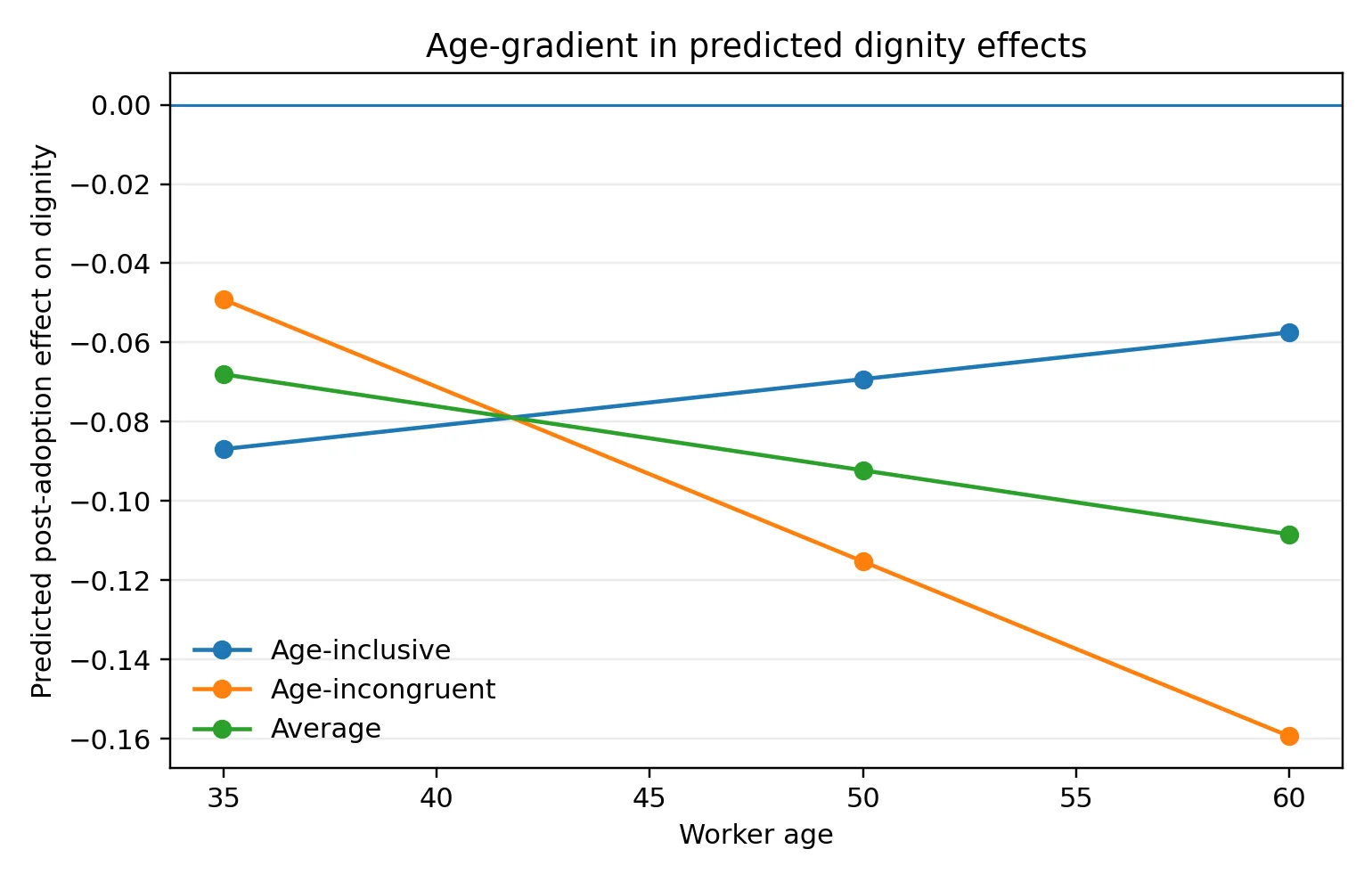
Cronbach's alpha was used to test reliability, and then descriptive and correlation analyses were carried out. The student used worker and wave fixed effects and unit-clustered standard errors in primary models. Predictors were post-adoption status and the interaction between post-adoption status and age, architecture, and governance. Loss of dignity and loss of capability-conversion were the co-primary outcomes. The age-inclusive, average, and age-incongruent system conditions were used to project the effects at 35 years of age, 50 years of age, and 60 years of age.
The identifying equation was:
Y_i t=α_i+lambda_t+β_1 Post_u t+β_2(Post_u txAge_i)+β_3(Post_u txArchitecture_u)+β_4(Post_u txAge_i xArchitecture_u)+β_5(Post_u txGovernance_u)+β_6(Post_u txAge_i xGovernance_u)+ϵ_i t
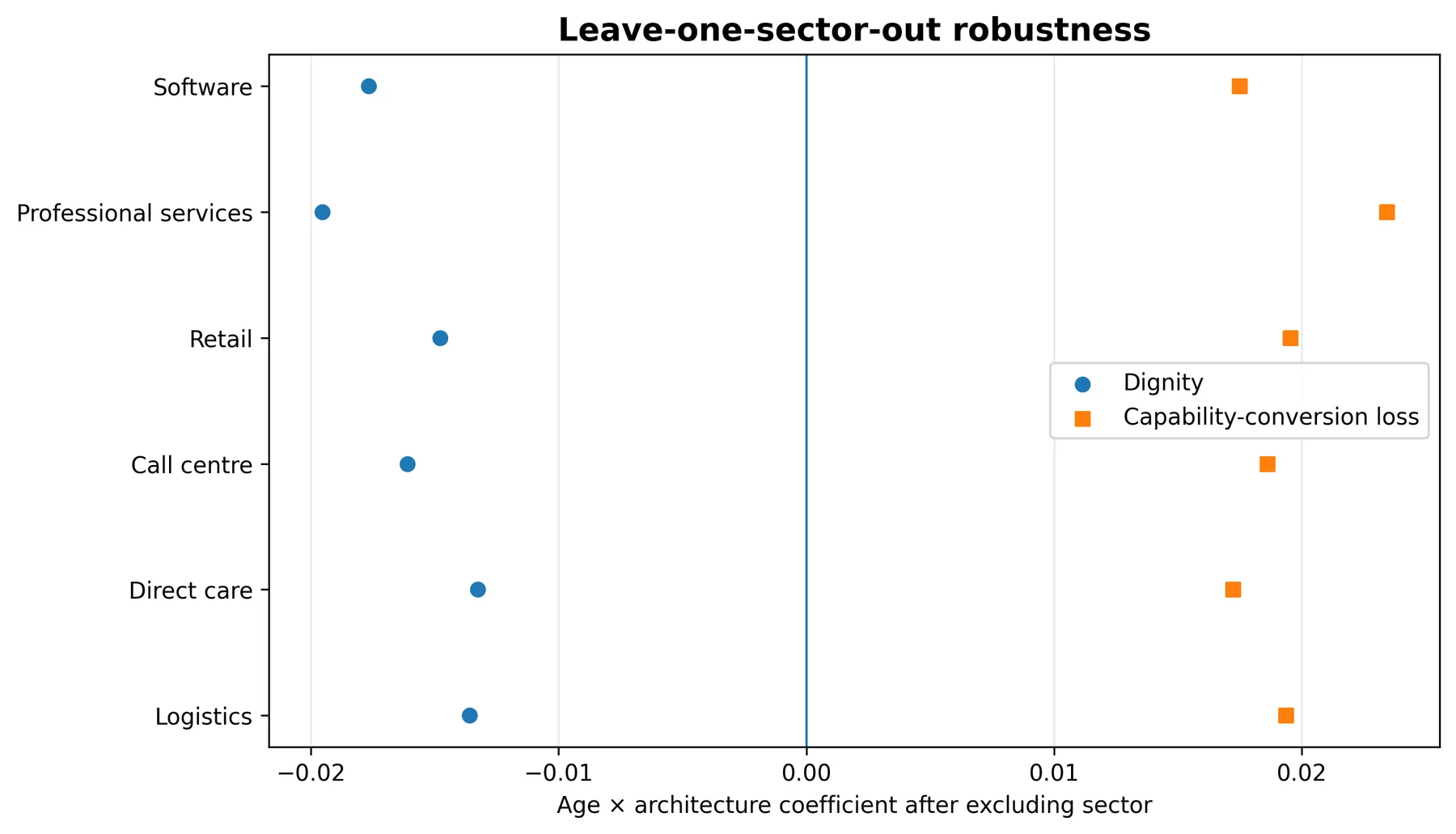
Stable individual differences and common time shocks were controlled for using worker and wave fixed effects. The age was centred at 45 and scaled by decade; the standardization of architecture and governance were decided. Co-primary estimands were the post by age by architecture effects on dignity and capability-conversion loss (with Holm correction). Dynamic effects were measured with a cohort-stacked event study design that compares treated units with never treated and not yet treated units (Callaway & Sant’Anna, 2021; Sun & Abraham, 2021). Pre-trends were tested with joint Wald tests, and unit-clustered standard errors were supplemented by 1,500 cluster-bootstrap replications. The criterion validity was used to determine if there was a difference in objective quality at the same objective score at the time of adoption, depending on the age when the adoption occurred. Those who scored low but were found to be of high quality were classified as false negatives and older-worker odds ratios were estimated using cluster logistic models. The associations between architecture exposure and dignity and capability loss, to employability and to retirement intention were determined by 1,000 unit-level bootstraps. Two cause-specific hazard models were used, one for retirement and one for resignation. Inverse probability weighting, complete-panel restriction, alternative age thresholds, cluster-bootstrap intervals, and leave one sector out analysis were all used to perform robustness checks.
Results
Descriptive and Measurement Results
At baseline, 4,515 workers provided dignity data. Respondents below age 50 had a mean dignity score of 3.91 (SD = 0.49), compared with 3.88 (SD = 0.51) among workers aged 50 and above. Mean capability-conversion loss was 2.26 (SD = 0.51) and 2.28 (SD = 0.50), respectively. Baseline retirement intention differed more sharply because age and pension eligibility were part of the generating process: 1.46 (SD = 0.51) below age 50 and 2.62 (SD = 0.72) at age 50 or above. The dignity items produced alpha = .720 overall, .712 below age 50, and .732 at age 50 or above. Capability-conversion-loss reliability was alpha = .763 overall, .758 below age 50, and .771 at age 50 or above. These values were adequate for the demonstration but deliberately below near-perfect reliability, preserving realistic attenuation and item noise. Baseline dignity correlated negatively with capability-conversion loss (r = -.127) and positively with employability (r = .155). Performance score and objective quality were strongly associated overall (r = .852), illustrating why aggregate accuracy alone can conceal differential error.
Pre-Treatment Trends and Dynamic Effects
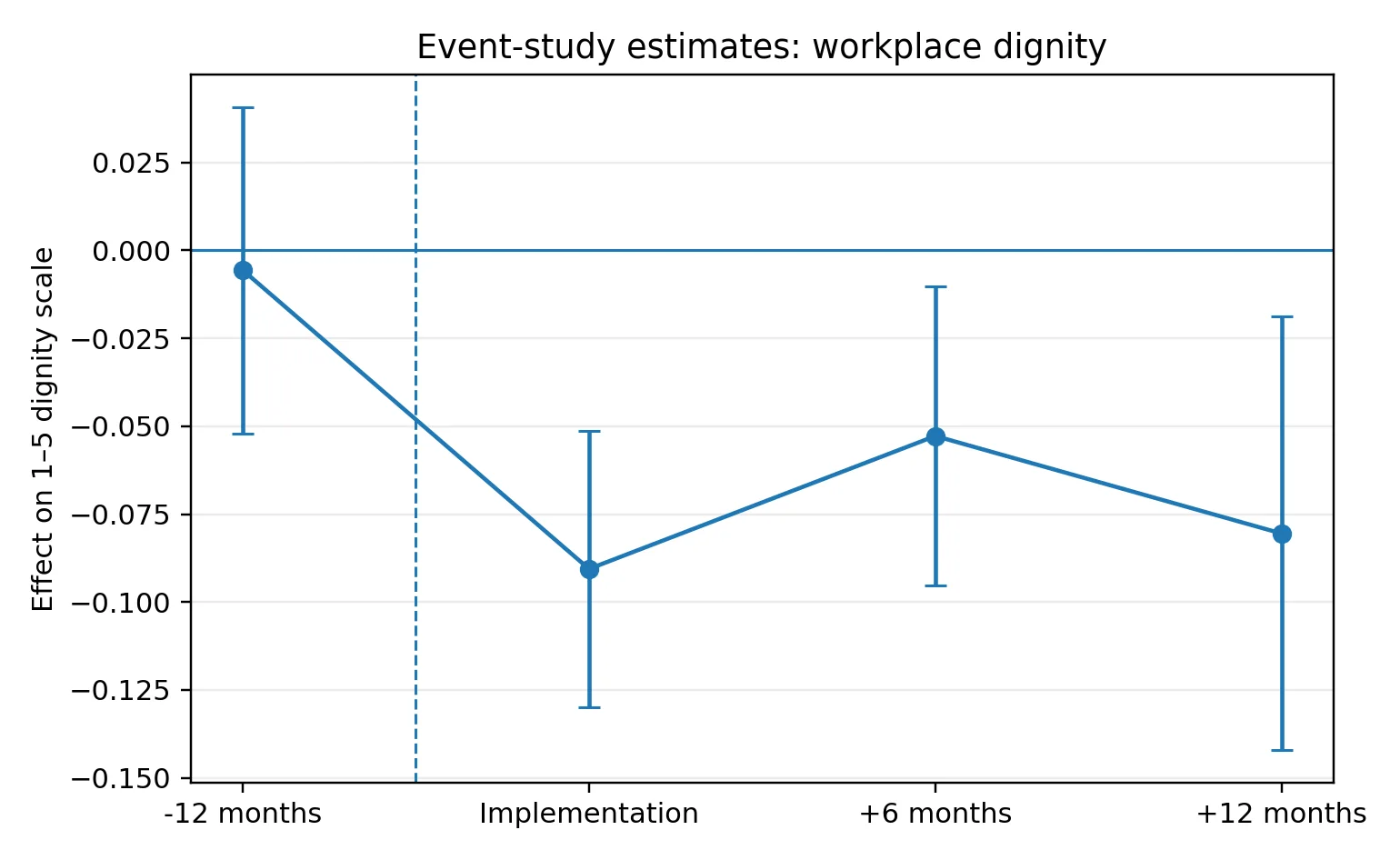
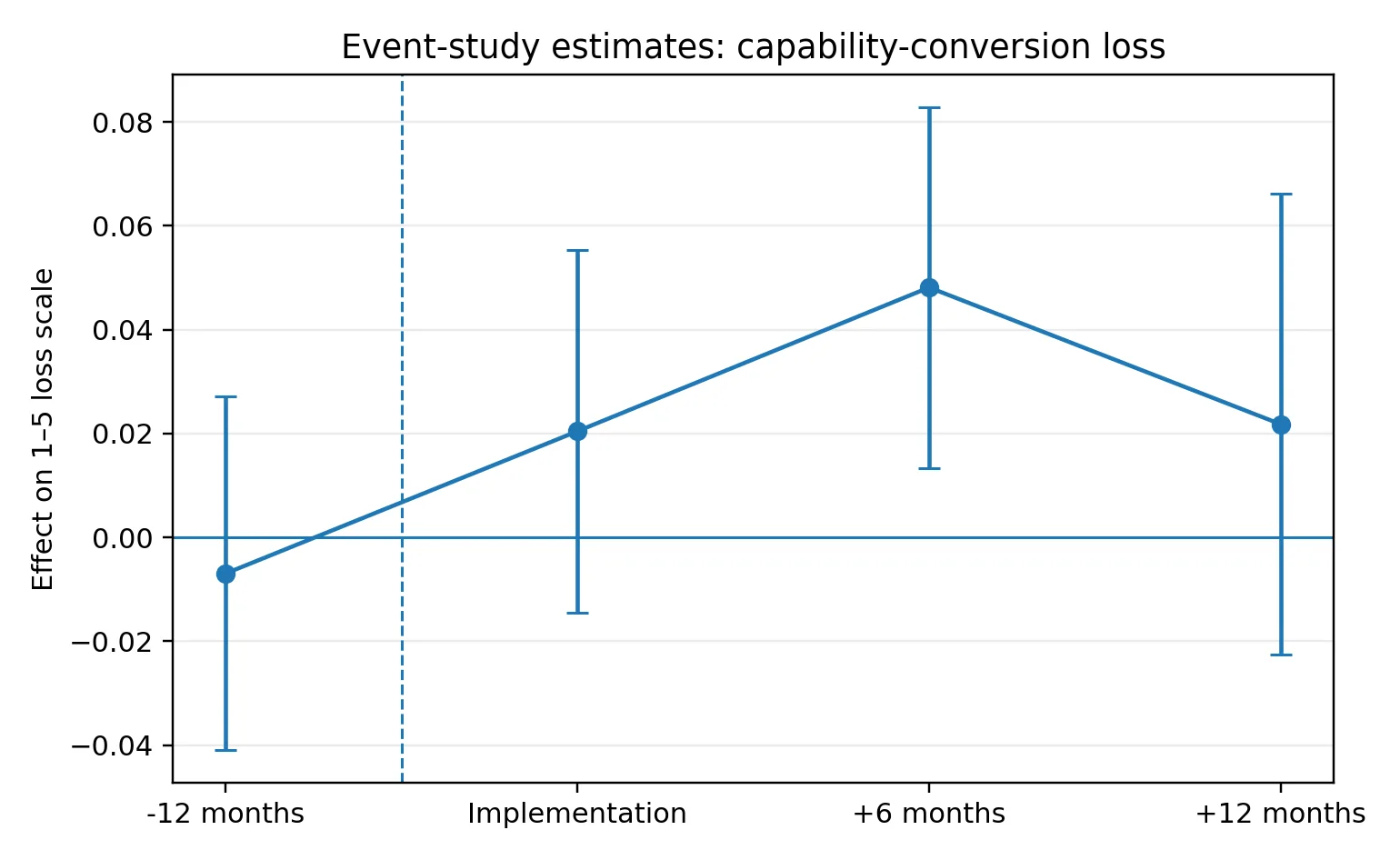
The cohort-stacked event study did not detect differential pre-treatment movement. For dignity, the event-time -2 coefficient was -0.006 (95% CI [-0.052, 0.041]) and its age interaction was 0.002 (95% CI [-0.009, 0.012]); the joint pretrend test yielded p = .932. For capability-conversion loss, the corresponding estimates were -0.007 and 0.003, with a joint p = .755. The treatment therefore begins from parallel observable trajectories rather than from an engineered anticipatory decline. Dignity declined immediately at implementation by 0.091 points (95% CI [-0.130, -0.051]) and remained lower at six months (-0.053, 95% CI [-0.095, -0.010]) and 12 months (-0.081, 95% CI [-0.142, -0.019]). The adverse age gradient emerged more clearly after implementation: the age interaction was -0.017 per decade at six months (p = .017). Capability-conversion loss showed a positive age differential at implementation (0.026 per decade, p = .002), at six months (0.038, p < .001), and at 12 months (0.041, p < .001).
Table 3. Cohort-stacked event-study estimates
| Outcome | Event term | Estimate | 95% CI | p |
|---|---|---|---|---|
| Workplace dignity | Event time -2 | -0.006 | [-0.052, 0.041] | .812 |
| Workplace dignity | Event time -2 × age (10y) | 0.002 | [-0.009, 0.012] | .754 |
| Workplace dignity | Implementation wave | -0.091 | [-0.130, -0.051] | < .001 |
| Workplace dignity | Implementation × age (10y) | -0.012 | [-0.026, 0.002] | .098 |
| Workplace dignity | +6 months | -0.053 | [-0.095, -0.010] | .015 |
| Workplace dignity | +6 months × age (10y) | -0.017 | [-0.031, -0.003] | .017 |
| Workplace dignity | +12 months | -0.081 | [-0.142, -0.019] | .010 |
| Workplace dignity | +12 months × age (10y) | -0.017 | [-0.036, 0.002] | .072 |
| Capability-conversion loss | Event time -2 | -0.007 | [-0.041, 0.027] | .690 |
| Capability-conversion loss | Event time -2 × age (10y) | 0.003 | [-0.008, 0.014] | .566 |
| Capability-conversion loss | Implementation wave | 0.020 | [-0.014, 0.055] | .251 |
| Capability-conversion loss | Implementation × age (10y) | 0.026 | [0.010, 0.043] | .002 |
| Capability-conversion loss | +6 months | 0.048 | [0.013, 0.083] | .007 |
| Capability-conversion loss | +6 months × age (10y) | 0.038 | [0.020, 0.055] | < .001 |
| Capability-conversion loss | +12 months | 0.022 | [-0.023, 0.066] | .336 |
| Capability-conversion loss | +12 months × age (10y) | 0.041 | [0.024, 0.058] | < .001 |
Primary Fixed-Effects Estimates
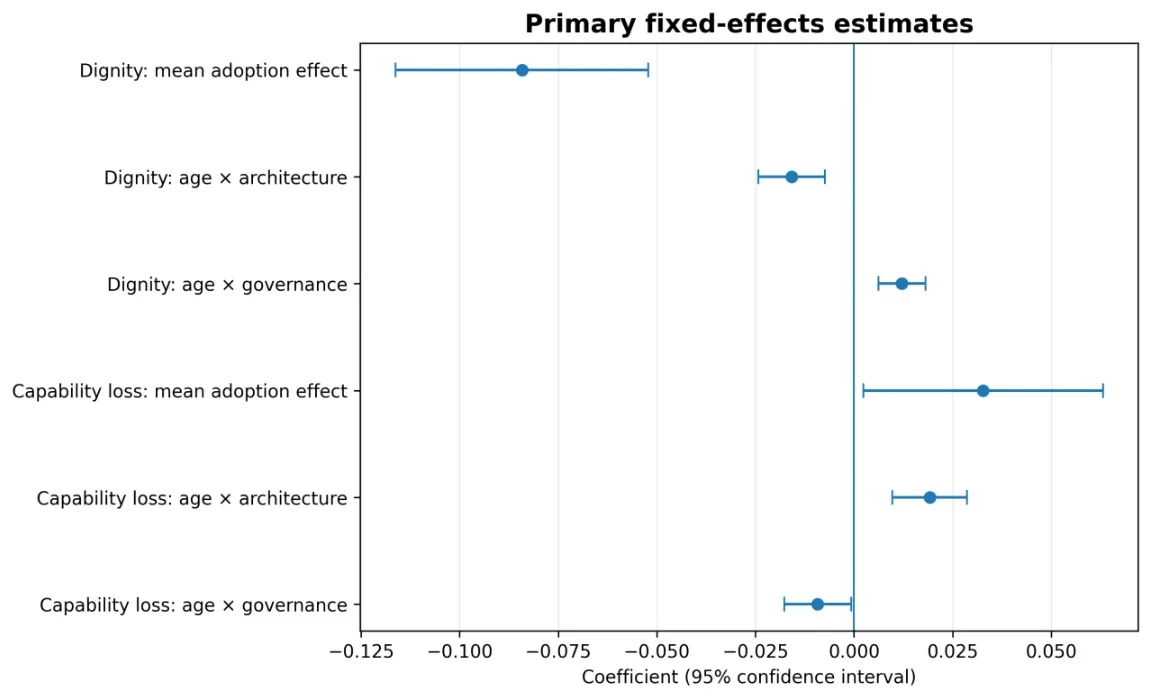
At mean age and system design, adoption reduced dignity by 0.084 points (95% CI [-0.116, -0.052], p < .001) and increased capability-conversion loss by 0.033 points (95% CI [0.002, 0.063], p = .035). Both effects became more adverse with age and age-incongruent architecture. The age-by-architecture interaction was -0.016 for dignity and +0.019 for capability-conversion loss (both adjusted p < .001). Inclusive governance significantly attenuated these gradients. For a 60-year-old worker in an age-incongruent, low-governance unit, predicted effects were -0.159 for dignity and +0.111 for capability-conversion loss. Under age-inclusive, high-governance conditions, the corresponding effects were -0.057 and +0.052. Thus, average effects understated the concentration of harm among older workers in poorly governed systems.
Table 4. Worker fixed-effects estimates with unit-clustered standard errors
| Outcome | Term | b | SE | 95% CI | p |
|---|---|---|---|---|---|
| Workplace dignity | Post-adoption effect at mean age/design | -0.084 | 0.016 | [-0.116, -0.052] | < .001 |
| Workplace dignity | Age differential per 10 years | -0.016 | 0.004 | [-0.025, -0.007] | < .001 |
| Workplace dignity | Architecture moderation | -0.003 | 0.012 | [-0.027, 0.021] | .812 |
| Workplace dignity | Age × architecture moderation | -0.016 | 0.004 | [-0.024, -0.007] | < .001 |
| Workplace dignity | Inclusive-governance moderation | 0.006 | 0.007 | [-0.008, 0.020] | .383 |
| Workplace dignity | Age × inclusive-governance moderation | 0.012 | 0.003 | [0.006, 0.018] | < .001 |
| Capability-conversion loss | Post-adoption effect at mean age/design | 0.033 | 0.015 | [0.002, 0.063] | .035 |
| Capability-conversion loss | Age differential per 10 years | 0.032 | 0.005 | [0.022, 0.043] | < .001 |
| Capability-conversion loss | Architecture moderation | 0.001 | 0.006 | [-0.012, 0.013] | .930 |
| Capability-conversion loss | Age × architecture moderation | 0.019 | 0.005 | [0.010, 0.029] | < .001 |
| Capability-conversion loss | Inclusive-governance moderation | 0.014 | 0.007 | [0.001, 0.027] | .034 |
| Capability-conversion loss | Age × inclusive-governance moderation | -0.009 | 0.004 | [-0.018, -0.001] | .033 |
Performance-Score Validity and Threshold Error
Performance scores strongly predicted objective quality (b = 0.643, p < .001), but aggregate accuracy concealed age-based miscalibration. At the same score, older workers showed higher objective quality after adoption (b = 0.093, p < .001), indicating systematic underprediction. They were also over three times more likely to receive a false-negative classification than younger workers (OR = 3.05, 95% CI [2.41, 3.86]). These results support Hypothesis 4 and show that overall predictive accuracy is insufficient for assessing fairness.
Table 5. Differential calibration of performance score against objective quality
| Term | Estimate | SE | 95% CI / count | p |
|---|---|---|---|---|
| score_z | 0.643 | 0.004 | [0.634, 0.651] | < .001 |
| older_50 | 0.177 | 0.007 | [0.164, 0.190] | < .001 |
| Treated_post | -0.047 | 0.009 | [-0.065, -0.029] | < .001 |
| older_50:treated_post | 0.093 | 0.016 | [0.062, 0.124] | < .001 |
| score_z:older_50 | -0.002 | 0.008 | [-0.017, 0.012] | .758 |
| score_z:treated_post | 0.004 | 0.008 | [-0.012, 0.019] | .653 |
| score_z:older_50:treated_post | -0.027 | 0.013 | [-0.053, -0.001] | .041 |
| False-negative rate, under age 50 | 1.51% | - | 85 / 5,631 | - |
| False-negative rate, age 50+ | 4.43% | - | 130 / 2,933 | - |
| Adjusted older-worker odds ratio | 3.046 | - | [2.406, 3.858] | < .001 |
Figure 5. Post-adoption performance-score calibration by age group
Mediation to Employability and Retirement Intention
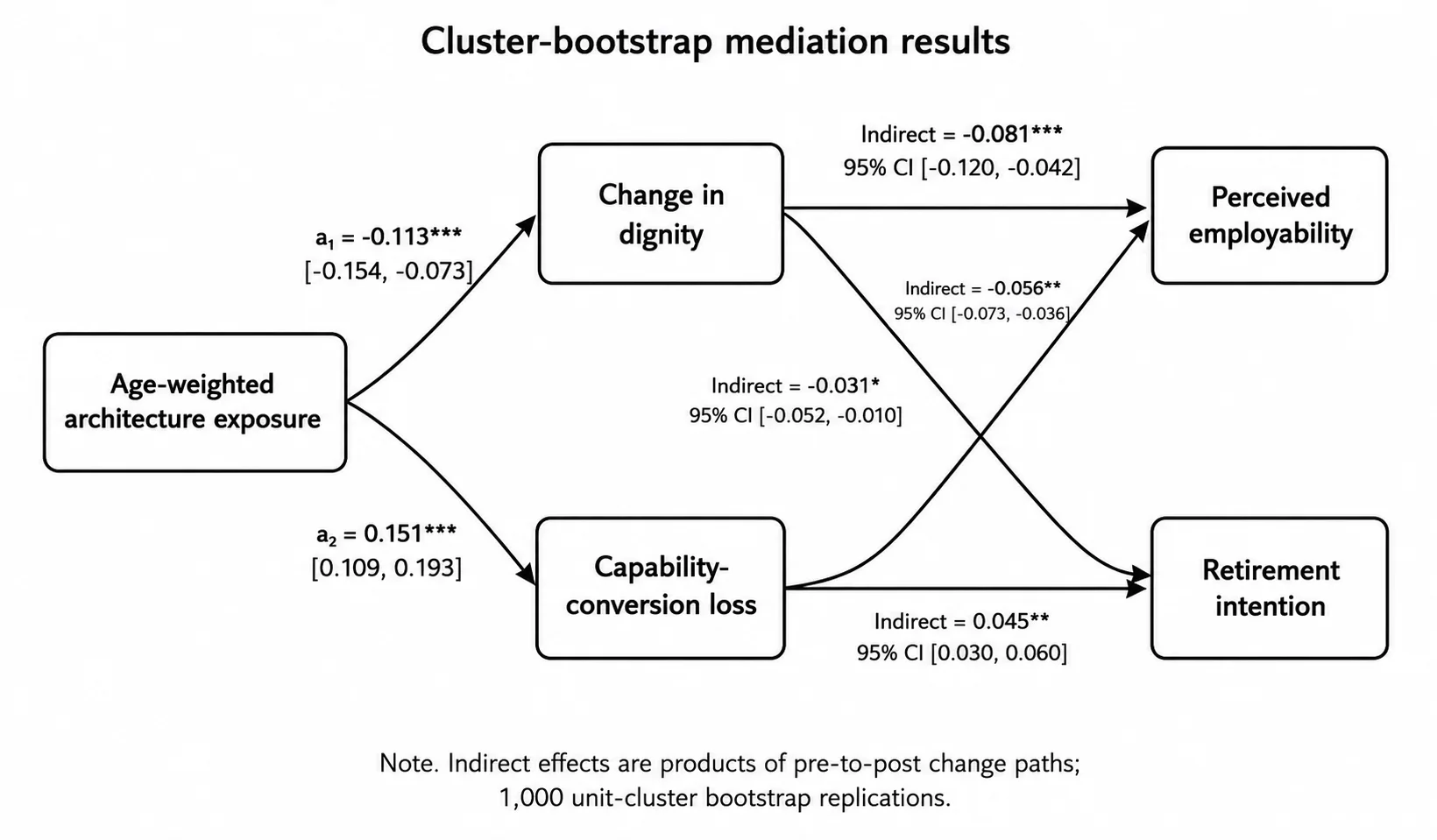
Inclusive governance and age-weighted architecture exposure had opposing trends, with inclusive governance improving dignity and architecture exposure decreasing capability-conversion loss. The two mediators had significant impact on both employability and retirement intention. The indirect effects on employability were: -0.031 (dignity) and -0.056 (capability-conversion loss). Indirect effects on intention to retire were found to be +0.031 and +0.045, respectively; with both effects being significant with no values of the bootstrap confidence intervals including zero. Direct effects were non-significant, supporting Hypothesis 5 that these mediators were the primary pathway for the relationship.
Table 6. Unit-cluster bootstrap indirect effects
| Indirect pathway | Effect | 95% cluster-bootstrap CI | Replications |
|---|---|---|---|
| Employability via dignity | -0.031 | [-0.042, -0.020] | 1000 |
| Employability via capability-conversion loss | -0.056 | [-0.073, -0.036] | 1000 |
| Retirement intention via dignity | 0.031 | [0.020, 0.043] | 1000 |
| Retirement intention via capability-conversion loss | 0.045 | [0.030, 0.060] | 1000 |
Employment Exit
During follow-up, 442 workers exited: 327 retired, 68 resigned, and 47 left for other reasons. Retirement intention was the strongest predictor of retirement (OR = 1.60, 95% CI [1.33, 1.92], p < .001). Once intention and life-course factors were included, dignity, capability-conversion loss, and architecture exposure had no direct retirement effects. Hypothesis 6 was therefore supported for the intention-to-retirement pathway, but not for a direct architecture-to-exit effect.
Table 7. Cause-specific discrete-time exit models
| Exit cause | Predictor | OR | 95% CI | p |
|---|---|---|---|---|
| Retirement | exit_dose | 0.966 | [0.502, 1.861] | .918 |
| Retirement | exit_gov | 1.235 | [0.718, 2.125] | .445 |
| Retirement | lag_dignity | 0.988 | [0.785, 1.242] | .916 |
| Retirement | lag_capability_conversion_loss | 0.990 | [0.783, 1.250] | .930 |
| Retirement | lag_retirement_intention | 1.600 | [1.332, 1.922] | < .001 |
| Resignation | exit_dose | 0.188 | [0.058, 0.612] | .005 |
| Resignation | exit_gov | 3.633 | [1.495, 8.827] | .004 |
| Resignation | lag_dignity | 0.904 | [0.579, 1.414] | .659 |
| Resignation | lag_capability_conversion_loss | 0.809 | [0.491, 1.332] | .405 |
| Resignation | lag_retirement_intention | 1.869 | [1.173, 2.977] | .009 |
Robustness and Sensitivity
Based on these analyses, it is concluded that convergent evidence is required to identify datafied ageism, which involves post-adoption within-worker change, stronger effects at older ages, moderation by age-incongruent architecture, attenuating effects through inclusive governance, and differential score validity. There is no single estimate that will do the job. While overall adoption impacts were small, those in high-risk systems had significantly larger impacts on their dignity loss and constraints on their ability to convert their skills. This was also accompanied by high overall predictive accuracy which masked under-prediction of the objective quality of the older worker and more common misclassification of the older worker as a false negative. Mean scores or overall accuracy are thus not the only means to assess fairness.
Table 8. Robustness of the age-by-architecture interaction
| Outcome | Specification | Estimate | 95% CI | p |
|---|---|---|---|---|
| Workplace dignity | Primary worker fixed effects | -0.016 | [-0.024, -0.007] | < .001 |
| Workplace dignity | Inverse-probability weighted fixed effects | -0.016 | [-0.024, -0.007] | < .001 |
| Workplace dignity | Complete five-wave non-exit panel | -0.022 | [-0.033, -0.010] | < .001 |
| Workplace dignity | 1,500 unit-cluster bootstrap | -0.016 | [-0.025, -0.007] | - |
| Capability-conversion loss | Primary worker fixed effects | 0.019 | [0.010, 0.029] | < .001 |
| Capability-conversion loss | Inverse-probability weighted fixed effects | 0.019 | [0.010, 0.029] | < .001 |
| Capability-conversion loss | Complete five-wave non-exit panel | 0.021 | [0.012, 0.029] | < .001 |
| Capability-conversion loss | 1,500 unit-cluster bootstrap | 0.019 | [0.010, 0.032] | - |
Discussion
What the Analyses Demonstrates
The analyses reveal convergent evidence of datafied ageism, including post-adoption evidence of within-worker change, the general power of the age effect, the moderation by age-incongruent architecture, the attenuation by inclusive governance, and differential score validity. There is no single estimate that will do the job. While overall adoption impacts were small, those in high-risk systems experienced significantly greater dignity loss and constraints on their ability to apply their skills. This was also accompanied by high overall predictive accuracy which masked under-prediction of the objective quality of the older worker and more common misclassification of the older worker as a false negative. Mean scores or overall accuracy are thus not the only means to assess fairness.
Theoretical Contributions
First, the study builds on algorithmic-management theory, by pointing to age differentiation in the design of evaluative architecture, not in the intensity of monitoring. Bad metrics include ones that cover a narrow range of constructs, use proxy measures that are age-dependent, have non-representative benchmarks, maintain scores outside the context of measurement, and link scores to consequential actions. Secondly, the article contributes to the study of workplace-ageism by outlining a structural pathway in the context of the process of continued employment. Even if a manager is not the one who is prejudiced, age-based disadvantage can result from formally age-neutral measurements and from his or her commonplace practice. This is a move towards systems that define, collect and process performance information rather than people. Third, capability-conversion loss provides a bridge between technical validity and lived opportunity. It captures whether workers can transform experience, judgment, health, effort, and expertise into contributions that the organization recognizes and rewards. Fourth, the model involves a distinction between dignity, capability conversion, employability, retirement intention, and actual retirement. This layered sequence explains why proximal psychological and opportunity effects may be strong even when direct effects on retirement or resignation remain limited.
Methodological Contributions
The study provides an illustration of a method suitable for the complexity of the datafied ageism. Worker fixed effects estimate within-person change, cohort-stacked event studies address staggered adoption, and system-audit interactions connect treatment effects to evaluative design. Validity is achieved with criterion-validity analysis and the role of competing exit pathways and organizational mechanisms is addressed with cluster-bootstrap mediation. Also, practical design constraints are identified. Moderation by system architecture is dependent on the number of independent organizational units, yet despite thousands of workers. The exit models are based on the number of real events, and not the number of worker waves observed. The precision is also affected by the reliability of measurements, selective response and limited pre-treatment periods. The synthetic dataset is thus a methodologically prototype dataset for planning field studies and testing other estimators prior to accessing sensitive employment data.
Organizational and Policy Implications
Construct validity should be assessed prior to using demographic parity or total predictive accuracy. Each metric needs to have occupation related criteria and be tested with several legitimate pathways to quality, safety and effective contribution. The threshold rules, age, tenure, assignment, health and work-pattern population groups should be documented and revalidated periodically for benchmark populations and downstream decisions. Inclusive governance should also be substantive. Human review is adding value when the reviewers have the ability to review inputs, see contextual evidence, fix errors, and override scores, and articulate their decision. All workers should be given access to information, clear explanations, places to fix mistakes, representation when appealing, and be protected from retaliation. Policy monitoring and control should not be limited to the hiring process, but should also include systems in place for existing employees. Performance technologies may impact training, schedules, pay, promotion, discipline, redeployment, and exit. Regulatory and collective-governance frameworks should therefore examine construct relevance, differential prediction, threshold errors, benchmark composition, data persistence, and contestability.
Limitations
The analysis necessarily simplifies organizational reality. Real implementations are accompanied by pilots, changes in configurations, adaptation in management, opposition from workers, vendor changes, and spillovers between teams. Objective quality can also be multi-dimensional and contested, not necessarily directly observable. The design was restricted to 48 independent units, and pre-treatment periods were restricted for early adopters. Time-varying confounding cannot be controlled by fixed effects, and when treatment varies in only a few units, it can be a source of sensitive clustered inference. Comparatively few exits were also influenced by pension eligibility, health, household finances, and labour-market opportunities. Finally, intersectional effects, including gender, disability, race, ethnicity, migration status, occupational class, and contract precarity, were not measured. Field research should be theoretically informed, focusing on intersections that are pre-specified, and small groups should not be made identifiable, and chronological age should not be treated as a necessary or uniform category.
Conclusion
The analyses reveal that algorithmic visibility turns age-stratified when evaluative systems narrow their definition of competent work, when they are based on age-correlated proxies, when they are based on non-inclusive benchmarks, when they maintain scores beyond their context, and when they limit interpretation or challenge. These features lowered dignity, limited the ability to convert, lowered employability and raised the intention of retirement, especially among older employees in poorly governed systems under programmed conditions. The key methodological takeaway is that there needs to be convergent evidence for a credible diagnosis. All of the above must be considered in the context of "longitudinal change," "system audits," "criterion-validity tests," "worker-experience measures," "threshold-error analysis," and "downstream consequences. The simulation offers a rigorous and repeatable way to validate in the field; the simulation coefficients are not meant to be taken as estimates in real workplaces.
Declarations
Ethics statement: The study used human participants, personal data, or proprietary organizational records.
Funding: No external funding was used to collect the data or conduct the reported analyses.
Conflict of interest: The authoring team reports no conflict of interest in relation to the study.
Data and code availability: The full sample, worker, and worker-wave datasets; data dictionary; analysis outputs; figures; and reproducibility script accompany the manuscript. The fixed random seed is 20260715.
References
- Allan, B. A., Batz-Barbarich, C., Sterling, H. M., & Tay, L. (2019). Outcomes of Meaningful Work: A Meta‐Analysis. Journal of Management Studies, 56(3), 500–528. https://doi.org/10.1111/joms.12406
- Ball, K. (2010). Workplace surveillance: An overview. Labor History, 51(1), 87–106. https://doi.org/10.1080/00236561003654776
- Bankins, S., Formosa, P., Griep, Y., & Richards, D. (2022). AI Decision Making with Dignity? Contrasting Workers’ Justice Perceptions of Human and AI Decision Making in a Human Resource Management Context. Information Systems Frontiers, 24(3), 857–875. https://doi.org/10.1007/s10796-021-10223-8
- Bernstein, E. S. (2017). Making Transparency Transparent: The Evolution of Observation in Management Theory. Academy of Management Annals, 11(1), 217–266. https://doi.org/10.5465/annals.2014.0076
- Blustein, D. L., & Allan, B. A. (2025). Dignity at Work: A Critical Conceptual Framework and Research Agenda. Journal of Career Assessment, 33(3), 489–509. https://doi.org/10.1177/10690727241283685
- Bujold, A., Parent-Rocheleau, X., & Gaudet, M.-C. (2022). Opacity behind the wheel: The relationship between transparency of algorithmic management, justice perception, and intention to quit among truck drivers. Computers in Human Behavior Reports, 8, 100245. https://doi.org/10.1016/j.chbr.2022.100245
- Callaway, B., & Sant’Anna, P. H. C. (2021). Difference-in-Differences with multiple time periods. Journal of Econometrics, 225(2), 200–230. https://doi.org/10.1016/j.jeconom.2020.12.001
- Curchod, C., Patriotta, G., Cohen, L., & Neysen, N. (2020). Working for an Algorithm: Power Asymmetries and Agency in Online Work Settings. Administrative Science Quarterly, 65(3), 644–676. https://doi.org/10.1177/0001839219867024
- Dordoni, P., & Argentero, P. (2015). When Age Stereotypes are Employment Barriers: A Conceptual Analysis and a Literature Review on Older Workers Stereotypes. Ageing International, 40(4), 393–412. https://doi.org/10.1007/s12126-015-9222-6
- Duggan, J., Sherman, U., Carbery, R., & McDonnell, A. (2020). Algorithmic management and app‐work in the gig economy: A research agenda for employment relations and HRM. Human Resource Management Journal, 30(1), 114–132. https://doi.org/10.1111/1748-8583.12258
- Fisher, G. G., Chaffee, D. S., & Sonnega, A. (2016). Retirement Timing: A Review and Recommendations for Future Research. Work, Aging and Retirement, 2(2), 230–261. https://doi.org/10.1093/workar/waw001
- Gandini, A. (2019). Labour process theory and the gig economy. Human Relations, 72(6), 1039–1056. https://doi.org/10.1177/0018726718790002
- Jarrahi, M. H., Newlands, G., Lee, M. K., Wolf, C. T., Kinder, E., & Sutherland, W. (2021). Algorithmic management in a work context. Big Data & Society, 8(2), 20539517211020332. https://doi.org/10.1177/20539517211020332
- Kellogg, K. C., Valentine, M. A., & Christin, A. (2020). Algorithms at Work: The New Contested Terrain of Control. Academy of Management Annals, 14(1), 366–410. https://doi.org/10.5465/annals.2018.0174
- Kleinberg, J., Ludwig, J., Mullainathan, S., & Sunstein, C. R. (2018). Discrimination in the Age of Algorithms. Journal of Legal Analysis, 10, 113–174. https://doi.org/10.1093/jla/laz001
- Komp-Leukkunen, K. (2023). A Life-Course Perspective on Older Workers in Workplaces Undergoing Transformative Digitalization. The Gerontologist, 63(9), 1413–1418. https://doi.org/10.1093/geront/gnac181
- Kornberger, M., Pflueger, D., & Mouritsen, J. (2017). Evaluative infrastructures: Accounting for platform organization. Accounting, Organizations and Society, 60, 79–95. https://doi.org/10.1016/j.aos.2017.05.002
- Lamont, R. A., Swift, H. J., & Abrams, D. (2015). A review and meta-analysis of age-based stereotype threat: Negative stereotypes, not facts, do the damage. Psychology and Aging, 30(1), 180–193. https://doi.org/10.1037/a0038586
- Lee, M. K. (2018). Understanding perception of algorithmic decisions: Fairness, trust, and emotion in response to algorithmic management. Big Data & Society, 5(1), 2053951718756684. https://doi.org/10.1177/2053951718756684
- Lucas, K. (2015). Workplace Dignity: Communicating Inherent, Earned, and Remediated Dignity. Journal of Management Studies, 52(5), 621–646. https://doi.org/10.1111/joms.12133
- Möhlmann, M., Zalmanson, L., Henfridsson, O., & Gregory, R. W. (2021). Algorithmic Management of Work on Online Labor Platforms: When Matching Meets Control. MIS Quarterly, 45(4), 1999–2022. https://doi.org/10.25300/MISQ/2021/15333
- Newman, D. T., Fast, N. J., & Harmon, D. J. (2020). When eliminating bias isn’t fair: Algorithmic reductionism and procedural justice in human resource decisions. Organizational Behavior and Human Decision Processes, 160, 149–167. https://doi.org/10.1016/j.obhdp.2020.03.008
- Parent-Rocheleau, X., & Parker, S. K. (2022). Algorithms as work designers: How algorithmic management influences the design of jobs. Human Resource Management Review, 32(3), 100838. https://doi.org/10.1016/j.hrmr.2021.100838
- Posthuma, R. A., & Campion, M. A. (2009). Age Stereotypes in the Workplace: Common Stereotypes, Moderators, and Future Research Directions†. Journal of Management, 35(1), 158–188. https://doi.org/10.1177/0149206308318617
- Ravid, D. M., Tomczak, D. L., White, J. C., & Behrend, T. S. (2020). EPM 20/20: A Review, Framework, and Research Agenda for Electronic Performance Monitoring. Journal of Management, 46(1), 100–126. https://doi.org/10.1177/0149206319869435
- Sen, A. (2001). Development As Freedom. Oxford University Press USA - OSO.
- Sun, L., & Abraham, S. (2021). Estimating dynamic treatment effects in event studies with heterogeneous treatment effects. Journal of Econometrics, 225(2), 175–199. https://doi.org/10.1016/j.jeconom.2020.09.006
- Thomas, B., & Lucas, K. (2019). Development and Validation of the Workplace Dignity Scale. Group & Organization Management, 44(1), 72–111. https://doi.org/10.1177/1059601118807784
- Truxillo, D. M., Cadiz, D. M., & Hammer, L. B. (2015). Supporting the Aging Workforce: A Review and Recommendations for Workplace Intervention Research. Annual Review of Organizational Psychology and Organizational Behavior, 2(1), 351–381. https://doi.org/10.1146/annurev-orgpsych-032414-111435
- Vanhercke, D., De Cuyper, N., Peeters, E., & De Witte, H. (2014). Defining perceived employability: A psychological approach. Personnel Review, 43(4), 592–605. https://doi.org/10.1108/PR-07-2012-0110
- Veen, A., Barratt, T., & Goods, C. (2020). Platform-Capital’s ‘App-etite’ for Control: A Labour Process Analysis of Food-Delivery Work in Australia. Work, Employment and Society, 34(3), 388–406. https://doi.org/10.1177/0950017019836911
- Wilckens, M. R., Wöhrmann, A. M., Deller, J., & Wang, M. (2021). Organizational Practices for the Aging Workforce: Development and Validation of the Later Life Workplace Index. Work, Aging and Retirement, 7(4), 352–386. https://doi.org/10.1093/workar/waaa012
- Wood, A. J., Graham, M., Lehdonvirta, V., & Hjorth, I. (2019). Good Gig, Bad Gig: Autonomy and Algorithmic Control in the Global Gig Economy. Work, Employment and Society, 33(1), 56–75. https://doi.org/10.1177/0950017018785616
- Zacher, H. (2015). Successful Aging at Work. Work, Aging and Retirement, 1(1), 4–25. https://doi.org/10.1093/workar/wau006 Appendix A. Data-Generating Structure The data-generating process separates assumptions from estimated results. The indicators of the audit at the unit level have been extracted from the bounded distribution and mean has been calculated to create an age-incongruent architecture-index. Inclusive governance was negatively, but not perfectly, related to architecture. At wave 3, 18 units were adopted, 18 more were adopted at wave 4, and 12 units did not receive any treatment. The characteristics of workers were conditionally generated by age and sector, based on age, tenure, health, caretaking, pension eligibility, age stereotypes, and financial readiness. A latent contribution score was created that included worker heterogeneity, worker tenure, role complexity and health. Objective quality reflected contribution, expertise, tenure, and noise across waves whereas the activity proxy reflected pace, role complexity, health, and noise. The performance scores pre-adoption had been the amalgamation of quality and activity. Once adopted, construct-under-representative systems added weight for activity, and age-proxy-sensitive systems added age- and health-specific penalties. The loss of dignity, loss of capability, and the time effects, unit shocks, correlated residuals, and post-adoption effects by age, architecture, governance, score under-recognition, and event time were all stable worker propensities that generated dignity and capability-conversion loss. The following outcomes were created downstream: employability, intention to retire, and job satisfaction. Health, prior dignity, prior loss of capacity to be converted, and wave were important determinants of survey response. The factors influencing exit risk were age, retirement intention, health, dignity, loss of capability, system architecture, governance, pension eligibility and time. Exits were then categorized as retirement, resignation or other, which provided an analytically difficult but still clear context.
CITE THIS ARTICLE
Yeaqubi, A. M. (2026). Datafied Ageism at Work: How AI-Based Performance Visibility Shapes Dignity and Late-Career Sustainability. https://www.researchbyyeaqubi.com/article/b779844c-94e5-4d8e-84d2-b7b2f445e8a9
A. M. Yeaqubi, “Datafied Ageism at Work: How AI-Based Performance Visibility Shapes Dignity and Late-Career Sustainability,” 2026. [Online]. Available: https://www.researchbyyeaqubi.com/article/b779844c-94e5-4d8e-84d2-b7b2f445e8a9
Yeaqubi, A. M. (2026) ‘Datafied Ageism at Work: How AI-Based Performance Visibility Shapes Dignity and Late-Career Sustainability’. Available at: https://www.researchbyyeaqubi.com/article/b779844c-94e5-4d8e-84d2-b7b2f445e8a9
Yeaqubi, Abdullah Mohammad. “Datafied Ageism at Work: How AI-Based Performance Visibility Shapes Dignity and Late-Career Sustainability.” 2026, https://www.researchbyyeaqubi.com/article/b779844c-94e5-4d8e-84d2-b7b2f445e8a9.
Abdullah Mohammad Yeaqubi. “Datafied Ageism at Work: How AI-Based Performance Visibility Shapes Dignity and Late-Career Sustainability.” (2026). https://www.researchbyyeaqubi.com/article/b779844c-94e5-4d8e-84d2-b7b2f445e8a9.
Yeaqubi AM. Datafied Ageism at Work: How AI-Based Performance Visibility Shapes Dignity and Late-Career Sustainability. 2026. https://www.researchbyyeaqubi.com/article/b779844c-94e5-4d8e-84d2-b7b2f445e8a9
@misc{article_b779844c94e54d8e84d2b7b2f445e8a9,
  title = {Datafied Ageism at Work: How AI-Based Performance Visibility Shapes Dignity and Late-Career Sustainability},
  author = {Abdullah Mohammad Yeaqubi},
  year = {2026},
  url = {https://www.researchbyyeaqubi.com/article/b779844c-94e5-4d8e-84d2-b7b2f445e8a9},
}
TY - GEN AU - Abdullah Mohammad Yeaqubi TI - Datafied Ageism at Work: How AI-Based Performance Visibility Shapes Dignity and Late-Career Sustainability PY - 2026 UR - https://www.researchbyyeaqubi.com/article/b779844c-94e5-4d8e-84d2-b7b2f445e8a9 ER -